🔹This article provides a psychological and behavioral analysis of the Aviator game and is intended for educational and informational purposes only; it does not constitute any betting advice.
🔹In crash games like Aviator, the outcome isn’t solely determined by the multiplier; the player’s psychological state is also a crucial factor. Understanding the psychology behind Aviator is key for new players to develop a rational approach and for experienced players to maintain a consistent and stable gaming experience.
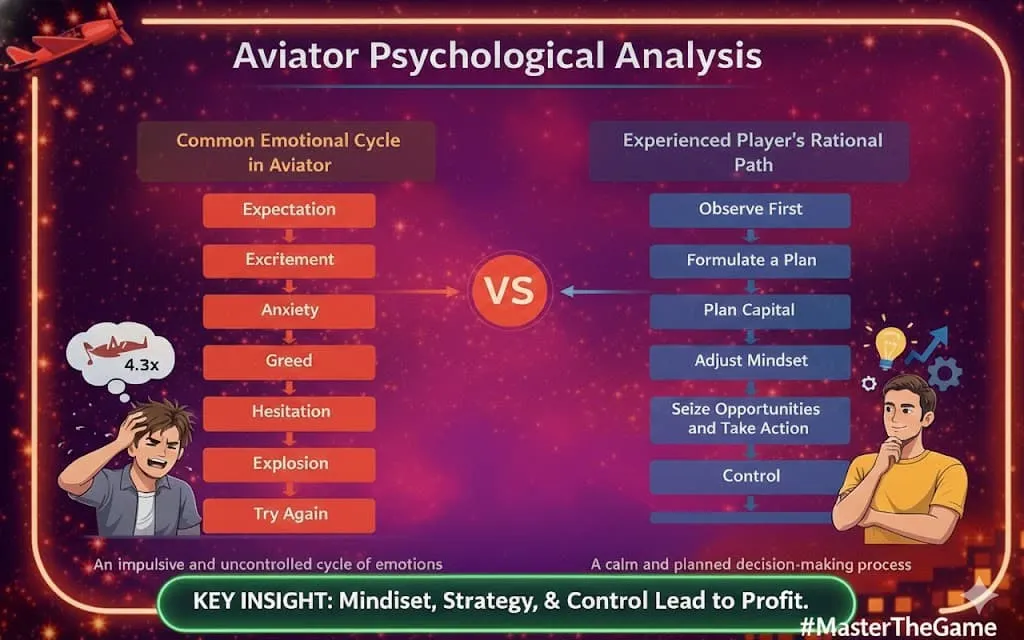
1️⃣ Common psychological cycles when first playing Aviator: Most beginners, when first encountering Aviator, unconsciously fall into the following psychological patterns:
🔹Anticipation → Excitement → Unease → Greed → Hesitation → Explosion → Regret → Try again
🔹Anticipation and excitement:
🔹When new players see a plane taking off for the first time and the multiplier rapidly increasing, they often become very excited about the game, believing that they can easily make a profit simply by “clicking faster.”
🔹Anxiety and greed coexist:
🔹When the multiplier approaches the psychological target, there’s a dual feeling of anxiety (“Will it explode soon?”) and hope (“I hope it goes up a little more”). Greed begins to outweigh rationality.
🔹Hesitation leads to mistakes:
🔹In that moment of hesitation, the plane exploded, and the bet was lost.
This wasn’t a matter of skill, but rather the inability to make a quick decision due to psychological factors.
🔹Regret and the urge to “try again”:
🔹After a loss, feelings of regret arise, leading to an attempt to compensate for the previous loss in the next round, thus repeating the cycle.
Without effective control and planning, this cycle will repeat continuously.
In summary: This is a typical example of uncontrolled aviator psychology.
2️⃣ The psychological journey of experienced Aviator players
🔹Unlike beginners, experienced players focus more on process control than on the outcome of a single game.
They typically follow these psychological steps:
🔹Observe first → Develop a plan → Allocate capital → Adjust your mindset → Seize opportunities and take action → Maintain control
🔹Observe first, don’t rush to bet: Experienced players will observe the rhythm of a few rounds, adjust their emotions, and get themselves into a calm state.
🔹Develop a plan and clearly define before the game starts: your exit strategy, acceptable risk level, and whether or not to participate in this round, instead of making decisions impulsing when the odds increase.
🔹Planning the principal: The betting amount for each round is kept within a controllable range, preventing emotional decisions in a single round from having a significant impact on the overall funds.
🔹Adjusting their mindset: They accept failure as a normal outcome and do not change their original strategy because of one or two setbacks.
🔹Seize opportunities to execute trades: “Executing trades” doesn’t mean chasing rising prices, but rather executing trades according to the plan.
🔹Control and stop in a timely manner: Knowing when to stop, whether upon reaching a set goal or when emotions fluctuate, is a crucial indicator of a mature aviator’s mindset.
In summary: Aviator is a game of psychology, not intuition.
🔹The randomness of Aviator cannot be changed, but players’ psychological states can be adjusted and managed.
Breaking free from the cycle of “anticipation-regret-try again” and shifting to a path of
🔹True maturity in an aviator‘s mindset isn’t about winning the most, but about minimizing loss of control.
Remember: your real opponent isn’t the game, but your own emotions. Staying calm is more important than any skill; rationality is always the best strategy.
🔹Aviator is a game of chance, and no psychological analysis or experience-based strategies can guarantee results. Please participate rationally, play within your means, and avoid addiction. Participation is prohibited for those under 21 years of age.
Understanding player psychology is only the first step; what truly influences the outcome is emotional control.
👉 Next reading: Why does the game “Pilot” easily trigger emotional fluctuations?
© 2026 AviatorGuide.com – All rights reserved.
This website is an indep
This website provides educational and informational content about Aviator-style crash games, focusing on gameplay mechanics, player psychology, and responsible decision-making.
We do not operate any gambling services and do not accept real-money bets.