
🔹This article contains psychological analysis of the game Aviator and is intended for educational and cognitive reference only. It does not constitute any betting advice.
1️⃣Most of those who immediately start betting are just giving money away to Aviator.
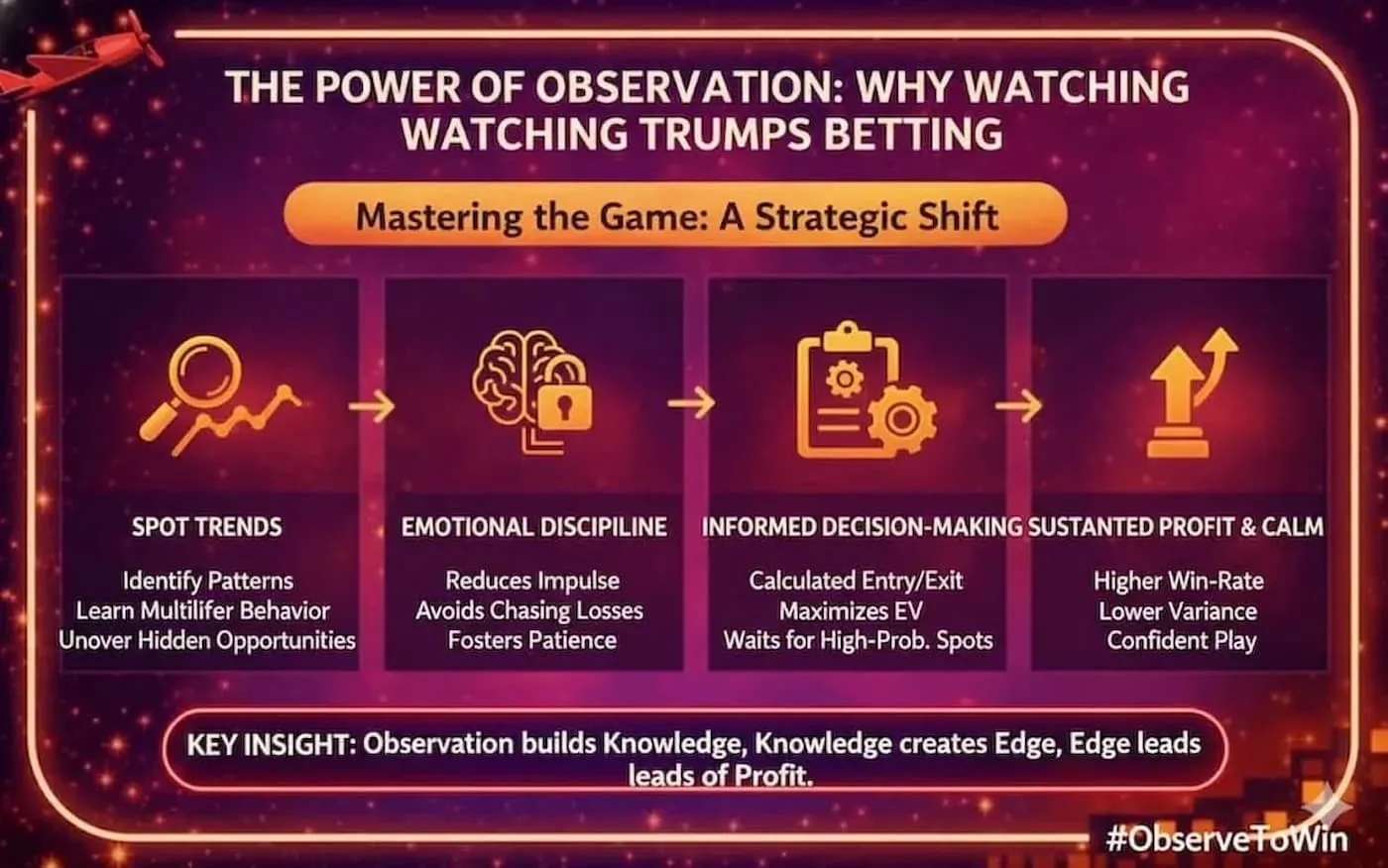
🔹 The biggest mistake in playing Aviator is “getting carried away and betting immediately”—newbies, upon entering the game, hearing the roar of the planes, watching the multiplier bar soar, and seeing the “10x withdrawal” announcement in the chat, immediately plunge in with a large bet, only to crash at 1.5x and be completely bewildered by the loss. Experienced players never do this. They enter the room without placing bets immediately, spending 10-20 minutes “waiting in”: watching the screen to record the crash multiplier, seeing if there are frequent low-multiplier bets (1.2-2x) or occasional high-multiplier bets (5x and above), and even paying attention to the intervals between the system’s “rain bonuses”.
🔹 I’ve learned my lesson the hard way about not observing before: right after registering, I blindly followed the trend and placed double bets, one at 2x and the other at 5x. The result was three consecutive losses around 1.8x, which wiped out half my initial capital. Later, I learned my lesson. Each time I logged in, I observed 20 games first. I noticed that during a certain period, planes mostly crashed between 2.2 and 2.8x, so I set my withdrawal threshold at 2.3x, and my win rate immediately improved. While Aviator doesn’t follow a pattern, you can see a “short-term probability distribution.” Blindly betting is like playing against randomness; observation helps you find high-probability intervals.
2️⃣ The core of observation is not finding patterns, but avoiding pitfalls and controlling the pace.
🔹 Don’t assume experienced players are observing to find signals that “high payouts are inevitable”; they’re actually trying to avoid traps. For example, if you see chat messages like “Go for 5x” or “Wait a bit longer,” it indicates a frenzied group mentality. In this case, Aviator is likely to crash with low payouts, so quickly reduce your bets or pause the game. If 10 consecutive rounds are low payouts, it doesn’t mean a high payout is coming; it’s a reminder not to chase losses and to stick to your existing withdrawal rules.
🔹 Observation can also help you understand your own state. Playing Aviator is most prone to “being blinded by the moment,” and staring at the screen for too long can lead to unconsciously following the multiplier’s impulses. Experienced players stop betting every three rounds to observe: see if they want to increase their multiplier after winning a couple of rounds, or if they want to increase their bet after losing. Once, I won five rounds in a row and wanted to raise the withdrawal threshold to 3x, but luckily I noticed my hands were starting to shake, so I quickly stopped betting to calm down, otherwise I would have suffered an early collapse at 1.6x in the next round—observation is like putting the brakes on your emotions.
3️⃣ An expert’s observation: Not even “hidden signals” are overlooked.
🔹 True Aviator veterans have a more detailed eye for detail. They pay attention to real-time payout data: if the payout rate remains below 95% for a period of time, it indicates the system is “manipulating the market,” so they decisively reduce their bets; if suddenly no one is shouting for high odds in the chat box, but veteran players are quietly withdrawing their winnings, it means everyone is avoiding pitfalls, and following suit and scaling back is definitely the right move.
🔹 There’s another hidden signal: system lag. Aviator occasionally experiences multiplier-level lag and sound delays. Those who notice this will immediately stop betting – it’s not that lag itself causes panic, but rather that it disrupts your judgment and slows down your reaction time for manual withdrawals. Once, the system lagged for 0.5 seconds, which I didn’t notice, and I continued waiting at my original pace for 2.3x. As a result, by the time the lag occurred, my bet had already crashed, and I lost a whole game – only by observing carefully can you take control.
Key conclusions:
🔹 Aviator‘s winning strategy never relies on “betting more,” but rather on “observing more games.” Observation isn’t a waste of time; it’s about understanding the game’s rhythm, avoiding emotional traps, and assessing your own situation at minimal cost. Beginners focus on “betting,” while experts prioritize “observation”—after all, in a completely random game, the only thing you can control is “when to bet and how much to bet,” and all of that depends on observation.
So the question arises: Does observation imply the existence of a pattern?
👉 Next reading: Does Aviator follow a certain pattern?
© 2026 AviatorGuide.com – All rights reserved.
This website is an indep
This website provides educational and informational content about Aviator-style crash games, focusing on gameplay mechanics, player psychology, and responsible decision-making.
We do not operate any gambling services and do not accept real-money bets.
